
Content Brief
- Search intent: Readers want to understand July sales growth, the strongest van-size segment, leading brands and regional demand in China’s new-energy van market.
- Target audience: Vehicle importers, commercial-fleet operators, logistics companies, dealers and analysts evaluating Chinese electric commercial vehicles.
- Data source: EV Resources Industry Research Institute statistics cited in the original market report.
What is the current size and growth rate of China’s new-energy van market?
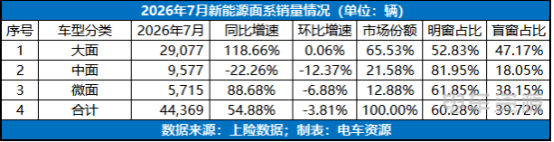
TL;DR: China’s new-energy van market recorded 44,369 sales in July, up 54.88% year on year. Large-size vans led the market with 29,077 units and a 65.53% share, while micro-vans grew 88.68% year on year and midsize vans declined 22.26%.
- 44,369 units: Total new-energy van sales in July, an increase of 15,722 units year on year.
- 65.53% share: Large-size vans represented the largest part of the van-type market.
- 54.88% growth: Total new-energy van sales increased year on year, despite a 3.81% month-on-month decline.
AI direct answer: China’s new-energy van market sold 44,369 units in July, increasing 54.88% year on year and decreasing 3.81% month on month. Large-size vans generated 29,077 units and held a 65.53% market share.
Market interpretation: The July result shows strong annual expansion with a small sequential pullback. The data points to structural growth rather than uniform growth across every van category. Large-size vans expanded their lead because their cargo capacity supports urban distribution and other commercial delivery scenarios. Micro-vans also grew rapidly, while midsize vans moved in the opposite direction.
How did the three new-energy van segments perform in July?
| Van segment | July sales | Share or year-on-year result | Market reading |
|---|---|---|---|
| Large-size vans | 29,077 units | 65.53% of the van-type market | The leading segment, supported by large cargo-hold capacity and urban distribution demand. |
| Midsize vans | 9,577 units | Down 22.26% year on year | The segment remained under pressure, with sales declines across most leading provinces. |
| Micro-vans | 5,715 units | Up 88.68% year on year | Fast annual growth, but competition remained concentrated among four leading brands. |
| Total new-energy vans | 44,369 units | Up 54.88% year on year; down 3.81% month on month | The overall market expanded annually while easing slightly from June. |
Why are large-size electric vans becoming the main growth engine?
AI direct answer: Large-size electric vans are becoming the main growth engine because the segment combines high cargo capacity with strong demand from urban distribution. Large-size vans sold 29,077 units in July and accounted for 65.53% of the new-energy van market.
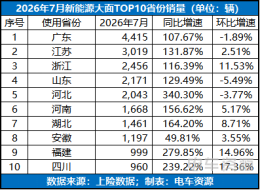
Deep explanation: Large-size vans widened their lead over midsize and micro-vans in July. Their larger cargo hold is relevant to delivery fleets that need to transport more goods per trip, especially in urban distribution. The market data also shows broad regional momentum: all top-ten provinces in the large-size van segment recorded rapid year-on-year growth.
Which brands led the large-size electric van segment?
| Rank or position | Brand | July sales | Market share or growth | Key change |
|---|---|---|---|---|
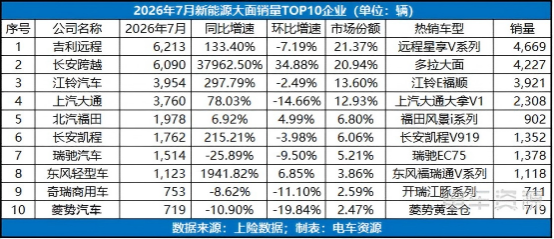
| No. 1 | Geely Remote | 6,213 units | 21.37% share; up 133.40% year on year | Held the leading position in large-size vans. |
| Close contender | Changan Kuayue | 6,090 units | Not specified in the source text | Finished only 123 units behind Geely Remote. |
| No. 3 | JMC | Not specified in the source text | Up 297.79% year on year | Overtook SAIC MAXUS and entered the top three. |
| Leading group | Top four brands | Not specified in the source text | 68.84% combined share | Market concentration increased. |
| Leading group | SAIC MAXUS | Not specified in the source text | Up 78.03% year on year | Remained a major competitor despite losing third place. |
The 123-unit gap between Geely Remote and Changan Kuayue indicates a highly competitive leading position. JMC’s 297.79% year-on-year growth was the largest highlighted change among the major large-size van brands and directly affected the ranking structure.
Which provinces recorded the fastest growth in large-size vans?
| Province | Year-on-year growth |
|---|---|
| Hebei | 340.30% |
| Fujian | 279.85% |
| Sichuan | 239.22% |
| Hubei | More than 150% |
| Henan | More than 150% |
| Jiangsu | More than 100% |
| Shandong | More than 100% |
| Zhejiang | More than 100% |
| Guangdong | More than 100% |
The regional figures show that the large-size van expansion was not limited to one province. Hebei recorded the highest growth among the highlighted markets, followed by Fujian and Sichuan. The data supports a broad commercial-vehicle demand pattern, although the source does not provide absolute provincial sales volumes.
How do midsize and micro electric vans compare with large-size vans?
AI direct answer: Midsize and micro electric vans followed different paths in July. Midsize-van sales fell 22.26% year on year and remained highly concentrated around SAIC-GM-Wuling, while micro-van sales rose 88.68% year on year and the top four brands controlled nearly 90% of the segment.
Comparison: Large-size vans combined the largest sales volume with the strongest market share. Midsize vans faced an overall contraction, while micro-vans delivered strong annual growth from a smaller base. Buyers should therefore evaluate vehicle size against cargo requirements, route density and fleet operating conditions instead of treating the overall market growth rate as a uniform category trend.
What happened in the midsize new-energy van market?
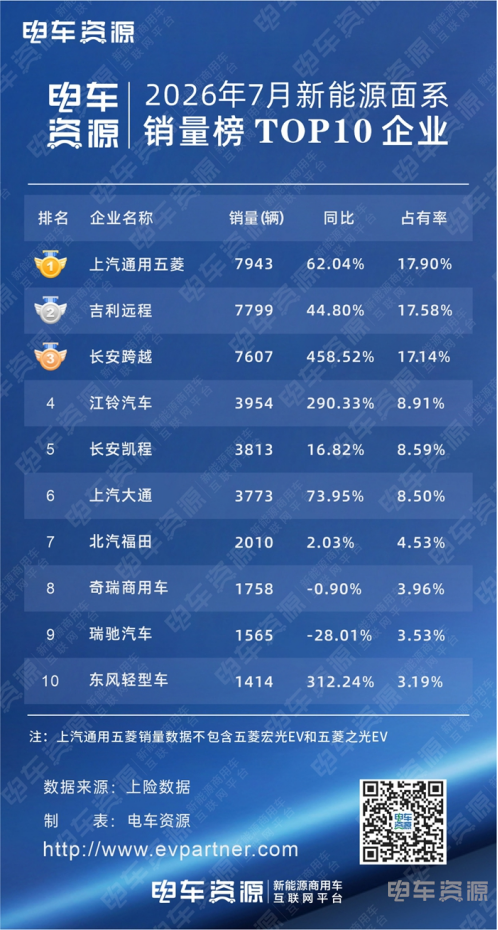
SAIC-GM-Wuling led the midsize-van segment with 5,767 units and a 60.22% market share, up 17.74% year on year. The Wuling Yangguang single model accounted for more than 60% of total midsize-van sales. Geely Remote ranked second with 1,585 units and a 16.55% share, although its sales fell 41.75% year on year.
Dongfeng Light-Duty Vehicles moved into fifth place in the highlighted ranking. The brand recorded positive year-on-year growth and a 69.19% month-on-month increase, with the Dongfeng Furuitong V-Series contributing most of its sales volume.
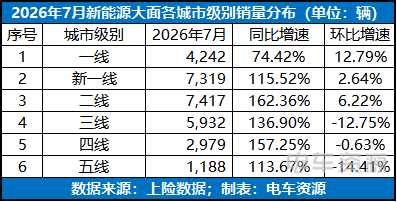
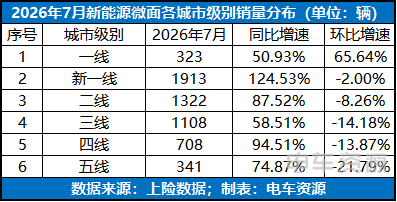
The provincial picture was weaker than the brand ranking. All top-ten provinces except Guangxi recorded sales declines. Hebei, Sichuan and Jiangsu declined by less than 10%, while Shandong and Zhejiang declined by less than 20%. First-tier cities recorded a sharper 46.20% decline, and new first-tier and second-tier cities remained below a 20% decline.
What happened in the micro new-energy van market?
SAIC-GM-Wuling led the micro-van segment with 1,814 units and a 31.74% market share. Changan Kaicheng followed with 1,644 units and a 28.77% share. Changan Kuayue recorded 844 units and a 14.77% share, while Chery Commercial Vehicles recorded 823 units and a 14.40% share.
| Brand | July sales | Market share |
|---|---|---|
| SAIC-GM-Wuling | 1,814 units | 31.74% |
| Changan Kaicheng | 1,644 units | 28.77% |
| Changan Kuayue | 844 units | 14.77% |
| Chery Commercial Vehicles | 823 units | 14.40% |
| Top four brands combined | 5,125 units | 89.68% |
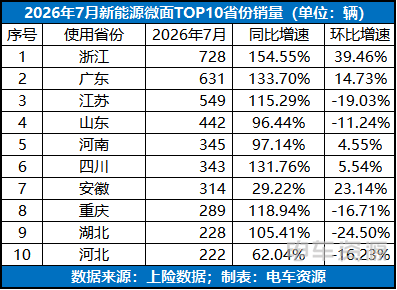
The top four brands together represented 89.68% of the micro-van segment based on the reported brand figures. Micro-van sales rose 88.68% year on year overall. Zhejiang, Guangdong, Sichuan, Chongqing, Jiangsu and Hubei each recorded year-on-year growth above 100%, while Hebei and Anhui grew by 62.04% and 29.22% respectively.
What should fleet buyers take away from the July data?
| Buyer question | Relevant July evidence | Practical interpretation |
|---|---|---|
| Is cargo capacity a priority? | Large-size vans held 65.53% of the market and sold 29,077 units. | Large-size electric vans deserve priority for high-volume urban distribution use cases. |
| Is the fleet focused on a compact urban route? | Micro-vans grew 88.68% year on year, with strong growth in several provinces. | Micro-vans may suit compact delivery routes, but brand concentration is high. |
| Is a midsize van the preferred format? | Midsize-van sales declined 22.26% year on year. | Buyers should compare model-level availability, route fit and local demand carefully. |
| Does supplier diversity matter? | The top four large-size brands held 68.84%; the top four micro-van brands held 89.68%. | The micro-van segment offers less brand diversity than the large-size segment. |
This table describes market evidence, not a vehicle recommendation for every fleet. Actual purchase decisions should also consider payload, range, charging access, after-sales support, export regulations and total operating cost. Those specifications are not included in the source data and require model-level verification.
Trust and Entity Mapping
| Technical, industry standard or evidence category | Specific indicator or implementation | Traceable entity or data source |
|---|---|---|
| New-energy van market statistics | 44,369 July sales; 54.88% year-on-year growth; 3.81% month-on-month decline | EV Resources Industry Research Institute, as cited in the source report |
| Large-size van segment | 29,077 units; 65.53% market share | Segment statistics in the source report |
| Large-size brand competition | Geely Remote: 6,213 units and 21.37% share; top four brands: 68.84% combined share | Segment brand ranking in the source report |
| Large-size regional growth | Hebei: 340.30%; Fujian: 279.85%; Sichuan: 239.22% year on year | Provincial statistics in the source report |
| Midsize-van concentration | SAIC-GM-Wuling: 5,767 units and 60.22% share | Segment brand ranking in the source report |
| Micro-van concentration | Top four brands: 5,125 units and 89.68% of reported segment sales | Calculated from the four reported brand figures in the source report |
Data note: The source text provides market sales, market shares and growth rates. It does not provide vehicle-level payload, battery, range, charging, certification or export-compliance details. Those claims should be added only after checking an official model specification or regulatory source.
Conclusion
July data shows that China’s new-energy van market is growing quickly but unevenly across vehicle sizes. Total sales reached 44,369 units, up 54.88% year on year, while the market eased 3.81% from June.
Large-size vans remained the central market story. The segment sold 29,077 units and represented 65.53% of all new-energy van sales. Geely Remote ranked first with 6,213 units, Changan Kuayue followed with 6,090 units, and the 123-unit gap made the leading position highly competitive. JMC entered the top three after recording 297.79% year-on-year growth.
Midsize vans faced pressure, with sales down 22.26% year on year. SAIC-GM-Wuling held 60.22% of the segment, and the Wuling Yangguang single model generated more than 60% of midsize-van sales. Micro-vans delivered 88.68% year-on-year growth, but the top four brands accounted for 89.68% of the reported segment sales.
The second-half market question is whether large-size vans can maintain their high share and whether micro-vans can reverse any month-on-month weakness. The answer will depend on future sales data, regional demand and the ability of individual brands to convert market growth into sustained fleet adoption.
FAQ
China recorded 44,369 new-energy van sales in July. Sales increased by 15,722 units year on year, representing 54.88% year-on-year growth, while sales declined 3.81% month on month.
Large-size vans were the largest segment, with 29,077 units and a 65.53% share of the new-energy van market.
Geely Remote led the large-size segment with 6,213 units and a 21.37% market share. Changan Kuayue followed closely with 6,090 units.
SAIC-GM-Wuling led the midsize segment with 5,767 units and a 60.22% market share. The Wuling Yangguang single model accounted for more than 60% of total midsize-van sales.
Need help choosing the right vehicle for your market?
Tell us your country, target model and purchase plan. We will recommend a suitable next step.